
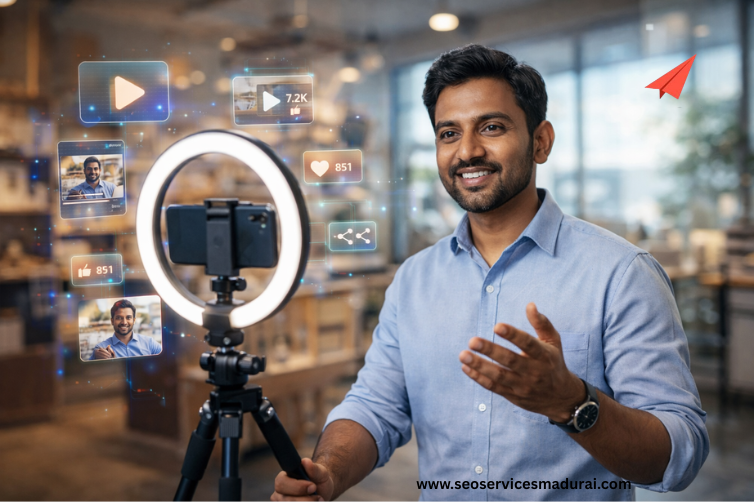
The digital landscape has fundamentally transformed, and video content now sits at the heart of successful marketing strategies. Statistics reveal a compelling truth: video content accounts for approximately 82 percent of all internet traffic, with 89 percent of businesses incorporating video into their marketing toolkit. More significantly for small business owners in Madurai, Tamil Nadu, and across India, 93 percent of marketers report excellent returns on investment from their video marketing efforts.
For small businesses competing in today’s crowded digital marketplace, video marketing is no longer optional—it represents the most powerful tool available for building brand awareness, engaging customers, and driving measurable business growth. At GegoSoft, we’ve witnessed countless local businesses transform their digital presence through strategic video marketing, generating leads, increasing sales, and establishing lasting customer relationships.
This comprehensive guide reveals everything small businesses need to know about video marketing in 2025, from understanding why video works to implementing practical strategies that deliver real results without requiring Hollywood-level budgets or production expertise.
Understanding the Video Marketing Revolution
Video marketing involves creating and distributing video content to promote products, services, brands, or messages across digital platforms. Unlike traditional text-based content, video combines visual storytelling, audio elements, and motion to create immersive experiences that capture attention and drive action.
The rise of video marketing stems from fundamental shifts in consumer behavior and technological advancement. Smartphones have become ubiquitous, with 77 percent of people using mobile devices to watch online videos. High-speed internet access has expanded dramatically across India, including smaller cities like Madurai, Sivakasi, and Dindigul, making video consumption seamless and enjoyable.
Social media platforms have evolved into video-first ecosystems. TikTok exists entirely for video content, Instagram and Facebook prioritize video in their algorithms, YouTube remains the second-largest search engine globally, and even LinkedIn now emphasizes video content for professional engagement. This platform evolution reflects what audiences want—and what they want is video.
Research consistently demonstrates video’s superior performance across key marketing metrics. Videos generate significantly higher engagement rates compared to text or static images, with users spending more time on pages containing video content. Websites with video content experience increased dwell time, reduced bounce rates, and improved search engine rankings. Email campaigns incorporating video achieve dramatically higher click-through rates, while landing pages with video convert visitors at substantially better rates than those without.
Why Video Marketing Works for Small Businesses
Video marketing delivers exceptional results for small businesses because it addresses several critical challenges simultaneously. First, video humanizes your brand in ways text and static images cannot match. When potential customers see real people behind your business—whether that’s you explaining your services, employees demonstrating products, or satisfied customers sharing testimonials—they form emotional connections that build trust and loyalty.
Second, video simplifies complex information. Rather than asking customers to read lengthy product descriptions or technical specifications, video demonstrations show exactly how products work, what problems they solve, and why customers should choose your business. A two-minute product demonstration video can communicate more effectively than several pages of written content.
Third, video drives measurable business outcomes. Studies show that 87 percent of people have been convinced to purchase products or services after watching videos about them, while 81 percent have downloaded or purchased applications following video exposure. These aren’t marginal improvements—they represent substantial increases in conversion rates that directly impact revenue.
Fourth, video levels the competitive playing field. While large corporations might have bigger marketing budgets, small businesses possess advantages that video amplifies beautifully: authentic stories, personal customer relationships, local expertise, and genuine passion. Well-crafted video content showcases these strengths effectively, allowing small businesses to compete with larger competitors for customer attention and market share.
Essential Types of Video Content for Small Business Success
Understanding which video types serve specific business objectives helps you allocate resources effectively and maximize returns. Each video format fulfills distinct purposes within your overall digital marketing strategy.
Explainer videos introduce your business, products, or services to potential customers. These typically run between 60 and 90 seconds, focusing on clearly articulating what you offer, who you serve, and why customers should choose your business. Research indicates that 98 percent of people have watched explainer videos to learn about products or services, making this format essential for businesses seeking to educate prospects and drive consideration.
Product demonstration videos show your offerings in action, highlighting features, benefits, and real-world applications. For service-based businesses, these might demonstrate processes, showcase before-and-after results, or illustrate the transformation clients experience. Product demos prove particularly valuable for businesses selling technical products, complex services, or innovative solutions that require visual explanation.
Customer testimonial videos leverage social proof—one of the most powerful marketing tools available. When satisfied customers describe their positive experiences, share specific results they achieved, and recommend your business to others, they provide authentic endorsements that influence purchasing decisions more effectively than any promotional message you could create. Video testimonials add credibility through facial expressions, tone of voice, and genuine emotion that written reviews cannot fully capture.
Behind-the-scenes videos offer glimpses into your business operations, introducing team members, showcasing your workspace, revealing production processes, or highlighting company culture. These videos build transparency and trust while differentiating your brand through authenticity. Audiences increasingly favor genuine, unpolished content over overly produced corporate videos, making behind-the-scenes content particularly effective for small businesses.
Educational content positions your business as an industry authority while providing genuine value to your audience. Tutorial videos, how-to guides, industry insights, and expert tips demonstrate your knowledge and expertise while helping potential customers solve problems. Educational content builds trust gradually over time, nurturing relationships that eventually convert viewers into paying customers.
Live video creates real-time engagement opportunities, allowing direct interaction with your audience through Q&A sessions, product launches, special announcements, or informal conversations. Live streaming generates urgency and exclusivity while fostering community among your followers. Platforms like Facebook, Instagram, YouTube, and LinkedIn all support live video broadcasting, making this format accessible to businesses of all sizes.
Creating Compelling Video Content on Small Business Budgets
Many small business owners assume video marketing requires significant investment in equipment, production services, and technical expertise. While professional production quality certainly has its place, the 2025 video marketing landscape increasingly rewards authenticity, creativity, and genuine connection over polish and perfection.
Modern smartphones possess remarkable video recording capabilities sufficient for most small business needs. Current iPhone and Android devices shoot high-definition video, capture excellent audio with external microphones, and offer built-in editing capabilities. Rather than investing thousands in professional camera equipment, most small businesses can produce quality video content using devices they already own.
Focus on three fundamental elements that matter more than expensive equipment: good lighting, clear audio, and stable footage. Natural window light often works beautifully for indoor shooting, while outdoor locations provide free, attractive lighting. Inexpensive ring lights available online for minimal investment dramatically improve indoor video quality. External microphones—costing between 1,000 and 5,000 rupees—substantially upgrade audio quality compared to built-in smartphone microphones. Simple tripods or smartphone stabilizers eliminate shaky footage, creating professional-looking videos without professional videographer costs.
Content quality matters more than production quality. A genuine, helpful video shot on a smartphone often outperforms an overly polished, corporate-feeling video created in a professional studio. Audiences in 2025 increasingly prefer authentic, relatable content over slick advertisements. Focus on delivering real value—solving problems, answering questions, providing insights—rather than achieving broadcast-quality production values.
Numerous free and affordable tools support video creation, editing, and distribution. Canva offers video creation templates and simple editing tools accessible to complete beginners. CapCut provides powerful mobile editing capabilities at no cost. DaVinci Resolve delivers professional-grade editing software completely free, though it requires more learning investment. iMovie comes preinstalled on Apple devices, offering solid editing functionality for basic needs.
Artificial intelligence tools increasingly democratize video creation. AI-powered platforms can generate video scripts, create automated captions, produce voiceovers, and even generate entire videos from text descriptions. While human creativity remains irreplaceable, these tools dramatically reduce the time and skill barriers that previously prevented small businesses from creating video content consistently.
Optimizing Videos for Maximum Reach and Engagement
Creating excellent video content represents only half the equation—optimizing that content for discovery and engagement completes the picture. Proper optimization ensures your videos reach target audiences, rank in search results, and drive meaningful business outcomes.
Platform-specific optimization acknowledges that each social media and video platform has unique technical requirements, audience expectations, and algorithmic preferences. YouTube videos perform best when optimized for search, with keyword-rich titles, detailed descriptions, and comprehensive tagging. Instagram and TikTok favor shorter, vertical format videos that capture attention within the first three seconds. LinkedIn audiences expect professional, value-driven content with educational or business development focus. Facebook videos should include captions since many users watch with sound off.
Understanding each platform’s video specifications prevents technical issues that reduce engagement. YouTube supports long-form horizontal video and offers extensive analytics. Instagram Reels require vertical 9:16 format and work best under 90 seconds. TikTok videos succeed at 15-60 seconds, again in vertical format. LinkedIn videos should be concise—two minutes or less—and include professional thumbnail images.
Video SEO optimization helps your content appear in both platform searches and broader Google searches. Include target keywords naturally in video titles without keyword stuffing. Write detailed descriptions that provide context, include relevant keywords, and encourage viewer action. Add accurate tags that categorize your content appropriately. Create custom thumbnails that grab attention while accurately representing video content.
Captions and transcripts serve multiple critical purposes. First, they make videos accessible to deaf and hard-of-hearing viewers, expanding your potential audience significantly. Second, they allow viewers to watch videos with sound off—crucial since many people browse social media in public spaces or during work breaks. Third, they provide search engines with text content to index, improving video searchability. Fourth, they accommodate viewers whose first language differs from the video’s spoken language.
Strategic call-to-action placement converts viewers into leads and customers. Every video should include clear next steps—visit your website, follow your social media accounts, subscribe to your channel, download a resource, schedule a consultation, or make a purchase. Position calls-to-action at video endings, include them in video descriptions, and mention them verbally during the video itself.
Developing a Sustainable Video Marketing Strategy
Random, inconsistent video creation rarely generates meaningful results. Successful video marketing requires strategic planning, consistent execution, and ongoing optimization based on performance data.
Begin by defining clear objectives aligned with broader business goals. Are you seeking to increase brand awareness among local audiences in Madurai and surrounding areas? Do you want to generate qualified leads for your web design services? Perhaps you aim to reduce customer support inquiries by creating educational content addressing common questions. Whatever your goals, clearly articulating them guides content creation and allows proper success measurement.
Understand your target audience deeply. Who are they? What challenges do they face? What questions do they ask? What types of content do they consume? Where do they spend time online? Creating detailed buyer personas helps you craft video content that resonates authentically with intended viewers rather than generic content that appeals to no one specifically.
Develop a content calendar outlining video topics, formats, publication schedules, and distribution channels. Consistency matters enormously in building audience and maintaining engagement. Whether you commit to weekly videos, bi-weekly content, or monthly releases, establish a schedule you can maintain sustainably over time. Sporadic video publication rarely builds momentum or generates lasting results.
Repurpose content strategically to maximize value from each video investment. A single 10-minute video can be edited into multiple shorter clips for social media platforms. Extract audio for podcast episodes. Transcribe content into blog posts. Create quote graphics from key insights. Transform demonstrations into step-by-step image guides. This multiplication effect ensures you’re not constantly creating entirely new content while maintaining active presence across multiple channels.
Batch production streamlines video creation and reduces production overhead. Rather than setting up equipment, preparing scripts, and recording individual videos one at a time, schedule dedicated recording sessions where you produce multiple videos consecutively. This approach dramatically improves efficiency while ensuring consistent visual style and quality across your video library.
Measuring Video Marketing Performance and ROI
Data-driven decision making separates successful video marketing from wasted effort. Tracking the right metrics provides insights into what’s working, what needs improvement, and where to allocate resources for maximum impact.
View count represents the most basic metric but also the least meaningful in isolation. While high view counts indicate content reach, they don’t confirm engagement quality or business impact. A video with 10,000 views that generates zero leads or sales delivers less value than a video with 500 views that converts 10 new customers.
Watch time and completion rate reveal whether viewers find your content engaging enough to watch beyond the first few seconds. High abandonment rates early in videos suggest problems with hooks, pacing, or relevance. Videos that viewers watch completely indicate strong content-audience alignment. Platform algorithms typically reward videos with high watch time and completion rates by showing them to more people.
Engagement metrics including likes, comments, shares, and saves demonstrate how viewers respond to your content. High engagement signals that content resonates emotionally, provides value, or sparks conversation. Shares particularly indicate that viewers find content valuable enough to recommend to others—the digital equivalent of word-of-mouth marketing.
Click-through rates measure how effectively videos drive traffic to designated destinations—your website, landing pages, product pages, or signup forms. Videos with strong calls-to-action and compelling value propositions generate higher click-through rates, translating video views into website visitors who can be further nurtured toward conversion.
Conversion tracking connects video marketing directly to business outcomes. How many video viewers complete desired actions? Do they fill out contact forms, download resources, schedule consultations, or make purchases? Proper conversion tracking reveals which videos drive genuine business results versus merely generating vanity metrics.
Return on investment calculation divides video marketing revenue by video marketing costs to determine profitability. Include all relevant costs—equipment, software subscriptions, time spent creating content, paid promotion—and track all attributable revenue from video-driven customers. Even modest video marketing efforts typically generate positive ROI when executed strategically, with many businesses reporting returns of 3:1, 5:1, or higher.
Emerging Video Marketing Trends Shaping 2025
Staying informed about evolving trends helps small businesses remain competitive and capitalize on emerging opportunities before markets become saturated.
Short-form video content continues dominating social media platforms. Instagram Reels, TikTok videos, YouTube Shorts, and similar formats favor quick, engaging content that captures attention instantly and delivers value rapidly. These bite-sized videos align perfectly with decreasing attention spans and mobile-first consumption patterns. Small businesses succeeding in 2025 master the art of communicating complete messages in 15-90 seconds.
Artificial intelligence integration transforms video production from creation through optimization. AI tools write scripts, generate voiceovers, create captions, suggest edits, and even produce entire videos from text descriptions. While AI won’t replace human creativity and authentic storytelling, it dramatically lowers barriers to entry and accelerates production timelines. Forward-thinking businesses experiment with AI tools to enhance efficiency while maintaining authentic human connection.
Interactive video elements increase engagement by transforming passive viewing into active participation. Clickable elements, embedded links, shoppable tags, polls, quizzes, and choose-your-own-adventure style branching narratives keep viewers engaged longer while providing valuable interaction data. Platforms increasingly support interactive features, making this format accessible to businesses willing to innovate beyond traditional linear video content.
Live commerce blends entertainment with e-commerce, allowing businesses to demonstrate products, answer questions in real-time, and facilitate immediate purchases without viewers leaving the platform. This trend, already massive in China and expanding rapidly across global markets, offers small businesses powerful tools for driving sales through engaging, authentic presentations.
Authenticity increasingly trumps production quality. Audiences in 2025 demonstrate growing preference for genuine, behind-the-scenes, slightly imperfect content over slick, corporate-feeling productions. This trend particularly benefits small businesses whose authenticity and personal touch naturally differentiate them from larger competitors. Stop worrying about perfect lighting and professional sets—focus instead on real stories, genuine personalities, and valuable information.
User-generated content and customer collaborations amplify reach while building community. Encourage customers to create videos featuring your products or services, share their experiences, or participate in challenges and campaigns. User-generated content serves as authentic testimonials while extending your content creation capacity exponentially. Feature customer videos on your channels, reshare their content, and celebrate their creativity to build stronger relationships and inspire others to participate.
Video Marketing for Different Business Types and Industries
While core video marketing principles apply universally, specific tactics vary based on business type, industry vertical, and target audience characteristics.
Retail businesses benefit enormously from product showcase videos highlighting features, demonstrating usage, and styling or pairing items. Behind-the-scenes videos showing product sourcing, creation processes, or quality control build transparency and trust. Customer unboxing videos, try-on demonstrations, and styling guides created by real customers provide authentic social proof that influences purchasing decisions.
Service-based businesses face unique challenges since they can’t simply show physical products. Instead, focus on outcome-focused videos demonstrating transformation clients experience, process videos explaining methodology and approach, expert interview content establishing authority, and case study videos detailing specific client success stories. Service businesses selling digital marketing services, consulting, coaching, or professional services particularly benefit from educational content that showcases expertise.
Restaurants and food businesses thrive with appetizing food preparation videos, chef interviews and cooking tips, customer reaction videos, seasonal menu highlights, and behind-the-scenes kitchen operations. Food content performs exceptionally well on social media, with Instagram and TikTok users particularly engaged with culinary content. Even simple smartphone videos of dishes being prepared can drive significant engagement and foot traffic.
Local service providers including plumbers, electricians, contractors, landscapers, and similar businesses build trust through educational how-to content addressing common customer questions, safety tips, and basic maintenance guidance. Before-and-after project videos showcase expertise and results. Customer testimonial videos featuring completed projects provide powerful social proof for prospects researching local service providers.
B2B companies benefit from thought leadership videos featuring company experts discussing industry trends, challenges, and solutions. Product tutorial videos help customers maximize value from complex products. Webinar recordings extend the reach of live events. Customer interview videos featuring business clients discussing partnership benefits provide compelling social proof for similar prospects evaluating solutions.
Leveraging Video Across Your Digital Marketing Ecosystem
Video content doesn’t exist in isolation—it should integrate seamlessly across your entire digital marketing presence, amplifying effectiveness of all marketing channels simultaneously.
Website integration transforms static web pages into engaging, conversion-focused experiences. Homepage videos introduce visitors to your brand immediately, making strong first impressions. Service pages benefit from explainer videos clarifying offerings and demonstrating value. Product pages should include demonstration videos showing items in use. About pages come alive with team introduction videos showcasing personality and culture. Testimonial videos embedded throughout the site provide social proof at crucial decision points.
Email marketing campaigns incorporating video achieve substantially higher click-through rates and engagement than text-only emails. Including the word “video” in email subject lines increases open rates. Embedding video thumbnails that link to hosted video content drives traffic while keeping email file sizes manageable. Welcome series, abandoned cart sequences, re-engagement campaigns, and promotional emails all benefit from strategic video integration.
Social media strategies should prioritize video content given algorithmic preferences favoring video posts. Develop platform-specific content rather than simply cross-posting identical videos everywhere. Create native content for each platform, respecting format preferences, audience expectations, and consumption contexts. Use video to spark conversations, encourage sharing, and build community among followers.
Paid advertising campaigns leverage video’s superior engagement and conversion rates. YouTube ads, Facebook and Instagram video ads, LinkedIn video ads, and even TikTok advertising all deliver strong returns when targeting is precise and creative is compelling. Video ads typically outperform static image ads in virtually every performance metric while often costing less per conversion.
Search engine optimization benefits from video integration since pages with video content rank better in search results. Video thumbnails in search results attract more clicks compared to text-only listings. YouTube videos themselves rank in Google search, providing additional opportunities for your business to appear in relevant searches. Proper video SEO ensures your content appears when potential customers search for solutions you provide.
Overcoming Common Video Marketing Challenges
Even with clear benefits, small businesses encounter obstacles when implementing video marketing strategies. Understanding common challenges and practical solutions helps you navigate potential pitfalls successfully.
Time constraints represent the most frequently cited barrier. Creating video content does require time investment, but efficiency improves dramatically with experience and proper systems. Start small with simple, informal videos rather than ambitious, complex productions. Batch record multiple videos in single sessions. Repurpose content strategically to maximize return on time invested. Remember that consistency with simple videos outperforms sporadic efforts at perfection.
Technical intimidation prevents many business owners from starting. Modern technology has made video creation remarkably accessible, requiring minimal technical knowledge. Smartphone cameras, simple editing apps, and free platforms remove previous barriers. Focus on learning one tool at a time rather than attempting to master entire ecosystems immediately. Numerous free tutorials teach fundamental video skills—invest a few hours learning basics, then improve gradually through practice.
Budget concerns often prove overblown. While professional video production costs thousands or tens of thousands of rupees per finished video, effective business videos can be created with minimal investment. Smartphone recording, free editing software, natural lighting, and genuine content deliver results without significant expenditure. As your comfort and skills grow, strategic equipment upgrades—better microphones, basic lighting, simple editing software subscriptions—enhance quality without breaking budgets.
Content ideas sometimes run dry, leaving businesses uncertain what to record. Systematic idea generation prevents this problem. Maintain an ongoing list of customer questions—each question represents a potential video topic. Monitor social media comments and messages for recurring themes. Survey customers about information they’d find valuable. Review competitor content for inspiration while ensuring you add unique perspectives. Catalog industry developments, seasonal topics, and trending discussions relevant to your business.
Fear of appearing on camera stops many entrepreneurs from creating video content despite recognizing its value. This fear typically diminishes with practice as you become comfortable with the recording process. Start with screen recordings, product demonstrations, or text-based videos requiring no on-camera appearance. Gradually introduce yourself through voice-only narration before eventually appearing on screen. Remember that audiences respond positively to authentic, genuine personalities—perfection isn’t the goal.
Building Long-Term Video Marketing Success
Sustainable video marketing success stems from commitment to continuous improvement, audience understanding, and strategic refinement over time rather than viral hits or overnight success.
Cultivate consistency over intensity. Regular, modest video publishing schedules maintained over months and years compound into substantial content libraries and engaged audiences. Weekly or bi-weekly videos sustained consistently deliver better results than ambitious daily publishing that burns out after a month.
Listen actively to audience feedback. Monitor comments, analyze questions, track engagement patterns, and survey viewers to understand what resonates and what falls flat. Let audience input guide content direction while maintaining authentic brand voice and perspective.
Experiment regularly with different formats, topics, lengths, and styles. Not every experiment succeeds, but each provides learning opportunities that inform future content decisions. What works for one business might not work for yours—testing reveals your unique formula for success.
Invest in skill development through online courses, tutorials, workshops, and practice. As your capabilities expand, video quality, creativity, and effectiveness improve correspondingly. Even modest skill improvements generate compounding returns over time as better content attracts larger audiences and drives more conversions.
Stay informed about platform changes, algorithm updates, emerging trends, and industry developments. The digital landscape evolves continuously—businesses that adapt quickly to changes maintain competitive advantages while those that ignore developments gradually lose relevance.
How GegoSoft Supports Your Video Marketing Journey
At GegoSoft, we recognize that video marketing represents a powerful growth opportunity for small businesses throughout Madurai, Tamil Nadu, and across India. We also understand that many business owners feel overwhelmed by technical requirements, time demands, and strategic complexity involved in successful video implementation.
Our comprehensive digital marketing services include video strategy development, content planning, technical guidance, and performance optimization. Whether you need help identifying effective video topics, optimizing content for search and social platforms, or measuring ROI from video investments, our experienced team provides the expertise and support necessary for success.
We work closely with clients to develop practical video marketing strategies aligned with business objectives, target audiences, and available resources. Rather than pushing one-size-fits-all solutions, we craft customized approaches that leverage your unique strengths, address specific challenges, and scale appropriately with your business growth.
For businesses seeking comprehensive support, we offer complete digital marketing solutions integrating video with SEO, social media management, email marketing, paid advertising, and content creation. This integrated approach ensures all marketing elements work synergistically, amplifying results while maximizing efficiency.
Taking the First Step Toward Video Marketing Success
The optimal time to start video marketing was several years ago. The second-best time is today. Every day you delay, competitors gain advantages, algorithms evolve, and opportunities slip away.
Your first video doesn’t need perfection—it needs existence. Record a simple introduction explaining who you are, what you do, and why customers should care. Film a quick product demonstration showing your offering in action. Capture a satisfied customer sharing their experience. Create a behind-the-scenes glimpse into your business operations.
Upload that video to YouTube, share it across social media platforms, embed it on your website, and include it in email communications. Analyze the response, learn from the experience, and create your second video incorporating lessons learned. Then your third, fourth, and fifth videos.
Within months, you’ll have developed skills, built content libraries, attracted audiences, and generated business results you never imagined possible. The journey of a thousand miles begins with a single step—and your video marketing journey begins with pressing the record button.
Conclusion: Embracing Video Marketing for Sustainable Growth
Video marketing in 2025 represents the single most powerful tool available to small businesses seeking to build brand awareness, engage customers, generate leads, and drive sales growth. With 82 percent of internet traffic consisting of video content and 89 percent of businesses leveraging video marketing, the question is no longer whether to adopt video marketing but rather how quickly you can implement effective strategies.
Small businesses in Madurai and across India possess unique advantages in the video marketing landscape. Your authenticity, local expertise, personal customer relationships, and genuine passion shine through video content in ways that large corporations struggle to replicate. Combined with accessible technology, affordable tools, and proven strategies, nothing prevents you from building successful video marketing campaigns that transform your business trajectory.
The businesses that thrive in coming years will be those that embrace video marketing wholeheartedly, experimenting boldly, learning continuously, and adapting quickly to evolving trends and audience preferences. Whether you’re a retail shop in Sivakasi, a service provider in Dindigul, or a manufacturer in Coimbatore, video marketing offers unprecedented opportunities to connect with customers and grow your business sustainably.
Don’t let fear, uncertainty, or perceived obstacles prevent you from accessing these opportunities. Start small, stay consistent, and commit to continuous improvement. The rewards—increased visibility, stronger customer relationships, higher conversion rates, and sustainable business growth—far exceed the modest investments required.
Ready to transform your business through strategic video marketing? Contact GegoSoft today to discuss how we can help you develop and implement video marketing strategies that deliver measurable results. Visit our contact page or schedule a free consultation to discover how video marketing can revolutionize your small business success in 2025 and beyond.