The search landscape has undergone a seismic transformation. Traditional search engine optimization—built around keywords, backlinks, and ranking positions—is evolving into something far more sophisticated: Generative Engine Optimization. As we navigate through 2026, businesses that continue focusing exclusively on traditional search rankings are being left behind while forward-thinking companies dominate AI-powered discovery across ChatGPT, Perplexity, Google’s AI Mode, and emerging answer engines.
The statistics reveal this fundamental shift. According to recent research, 83 percent of global consumers use Google and YouTube daily, but how they search has transformed dramatically. AI Overviews now appear on billions of searches, with click-through rates for traditional organic results declining as users find complete answers directly on results pages without clicking through to individual websites. ChatGPT processes over five billion monthly visits, making it the fourth most-visited website globally, while Perplexity has experienced 71 percent growth in referral traffic.
For small businesses in Madurai, Tamil Nadu, and across India, understanding and implementing Generative Engine Optimization isn’t futuristic speculation—it’s survival strategy for 2026. At GegoSoft, we’ve been pioneering GEO strategies since early AI answer engine development, helping businesses transition from traditional SEO to this new paradigm of search visibility. This comprehensive guide reveals everything you need to know about mastering GEO in 2026.
Understanding Generative Engine Optimization
Generative Engine Optimization represents the strategic process of optimizing content to be cited, recommended, and featured within AI-generated answers produced by large language models and AI answer engines. Unlike traditional SEO that aims for high rankings in search results lists, GEO focuses on becoming the authoritative source that AI systems reference when synthesizing information to answer user queries.
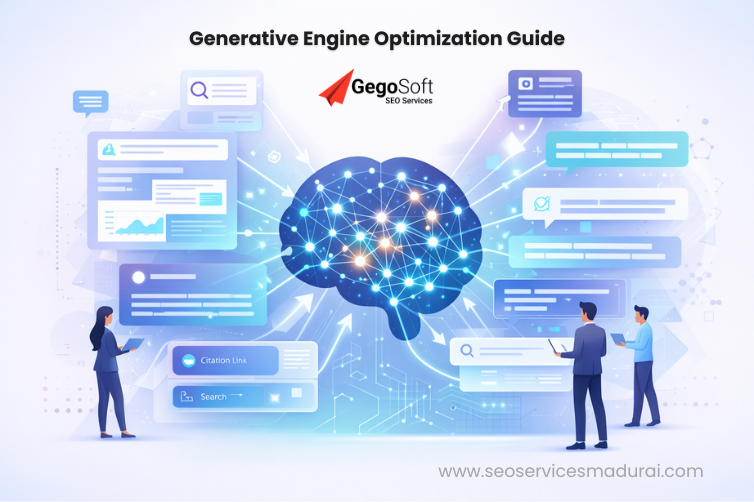
The fundamental difference lies in how content gets discovered and presented. Traditional search engines display ranked lists of websites matching query keywords, requiring users to click through multiple results to find comprehensive information. AI answer engines like ChatGPT, Perplexity, and Google’s AI Mode analyze vast information sources, synthesize insights from multiple authoritative sources, generate coherent comprehensive answers combining information seamlessly, and provide citations linking to original sources when appropriate.
When your content appears cited within an AI-generated answer, you gain implicit endorsement from the AI system as an authoritative source on that topic. This third-party validation builds trust more effectively than any self-promotion, positioning your business as the expert that even AI systems rely upon.
The competitive landscape for GEO remains relatively open in 2026. While large corporations have begun investing in GEO strategies, most small businesses haven’t adapted their approaches yet. This creates significant first-mover advantages for businesses implementing GEO optimization now, before markets become saturated and competition intensifies. The businesses establishing authority and citations in AI systems today will maintain advantages as these platforms become primary discovery channels.
The E-E-A-T Framework in AI-Powered Search
Google’s emphasis on Experience, Expertise, Authoritativeness, and Trustworthiness has become even more critical in AI-powered search. AI systems prioritize content demonstrating genuine authority because they’re trained to identify and reward quality signals that indicate reliable information.
Experience requires demonstrating firsthand knowledge about topics you cover. For service businesses like digital marketing agencies, this means sharing specific case studies showcasing actual client results, including concrete metrics and outcomes achieved. Generic advice that anyone could write gets ignored by AI systems, while detailed accounts of real situations you’ve navigated successfully signal authentic expertise.
Expertise demands comprehensive topic coverage that reveals deep subject knowledge. Surface-level content addressing topics superficially won’t earn AI citations. Instead, create thorough resources exploring topics from multiple angles, addressing common questions and uncommon edge cases, providing original insights based on your unique perspective, and including data, research, or proprietary information others cannot easily replicate.
Authoritativeness stems from establishing yourself and your business as recognized leaders within your industry. This involves earning mentions and citations from reputable industry publications, participating actively in professional communities and forums, speaking at industry events and conferences, and contributing original research or thought leadership that others reference.
Trustworthiness requires building credibility through consistency, transparency, and verification. AI systems cross-reference information across multiple sources to verify accuracy. When your content maintains consistent messaging across your website, social profiles, industry directories, and third-party mentions, AI systems gain confidence in your reliability. Inconsistencies damage trust and reduce citation likelihood.
Implementing author bylines with credentials and expertise indicators helps AI systems understand content authority. Include author bios highlighting relevant experience, qualifications, and track record. Link author names to author profile pages detailing their expertise comprehensively. This explicit signaling helps AI systems evaluate content credibility.
Optimizing Content Structure for AI Interpretation
AI systems don’t just read content—they parse structure, extract meaning, and evaluate whether information can be clearly understood and synthesized. Content optimization for AI requires different approaches than traditional SEO copywriting.
Write for two audiences simultaneously: humans seeking valuable information and AI systems evaluating your content for citation potential. This means maintaining natural, engaging language that readers appreciate while ensuring structural clarity that AI systems require. Avoid overly complex sentence structures with multiple clauses and unclear antecedents that confuse language models. Use clear, direct language with explicit subjects and objects.
Implement comprehensive heading hierarchies that map content organization clearly. Use H2 headings for major topic sections, H3 headings for subsections within major topics, and H4 headings for detailed points within subsections. This clear hierarchy helps AI systems understand information relationships and relative importance.
Answer questions directly and completely at the beginning of relevant sections. When addressing “How much does local SEO optimization cost for small businesses?”, provide a clear answer in the first 50-75 words before elaborating with supporting details. This structure accommodates both users seeking quick answers and AI systems extracting concise information for generated responses.
Use structured data markup extensively to provide explicit signals about content type, purpose, and context. Schema.org markup for articles, FAQs, how-to guides, local businesses, products, and reviews all help AI systems categorize and understand your content accurately. Proper schema implementation dramatically increases citation likelihood because it makes content easily interpretable.
Create comprehensive content hubs around core topics rather than isolated individual articles. Develop pillar pages covering broad topics thoroughly, supported by detailed cluster content addressing specific subtopics, with strategic internal linking connecting related content. This interconnected architecture signals topic authority that AI systems recognize and reward.
Conversational Query Optimization
AI-powered search emphasizes natural language queries rather than keyword strings. Users interacting with ChatGPT, Google’s AI Mode, or voice assistants ask questions conversationally, expecting comprehensive answers. Your content must address these natural language patterns to earn AI citations.
Research question-based queries your target customers actually use when seeking information about your services or products. Tools like Answer The Public reveal common question patterns, while Google’s People Also Ask sections show related queries. Analyze customer service inquiries, sales call questions, and support ticket topics—these reflect real information needs.
Structure content around complete questions as headings. Instead of “SEO Services Pricing,” use “How much should small businesses in India budget for professional SEO services?” This natural language framing aligns with how users query AI systems and increases chances of your content being selected as the authoritative answer source.
Provide comprehensive answers addressing not just the direct question but related considerations users might wonder about. When answering pricing questions, also address what’s included in services, how long results take, and what success looks like. This comprehensiveness makes your content more useful for AI systems synthesizing complete responses.
Include long-tail conversational phrases naturally throughout content. AI systems recognize semantic relationships and context rather than requiring exact keyword matches. Writing naturally about topics while covering them comprehensively serves both human readers and AI interpretation better than forced keyword insertion.
Building Authority Signals Across the Web
GEO success requires establishing authority beyond your own website. AI systems evaluate your broader digital footprint when determining whether to cite your content as authoritative.
Earn high-quality backlinks from reputable industry sources, educational institutions, government websites, established publications, and authoritative directories. Each quality backlink signals to AI systems that other trusted sources consider your content valuable and worth referencing. Focus on earning links through exceptional content and genuine relationships rather than manipulative link-building tactics.
Secure media coverage and press mentions that establish third-party validation of your expertise. When industry publications, local news outlets, or trade journals mention your business or quote your expertise, these independent endorsements build credibility that influences AI system assessments. Strategic press release distribution can help generate this coverage.
Participate actively in industry communities, forums, and professional networks where meaningful discussions occur. Answer questions on platforms like Reddit, Quora, and industry-specific forums with genuinely helpful insights. These contributions build digital footprints demonstrating expertise while earning exposure and potential backlinks.
Develop strong social media presence maintaining consistent messaging aligned with your website content. While social signals may not directly influence traditional SEO rankings, AI systems can access and evaluate social content when assessing brand authority and expertise. Active, engaged social presence strengthens overall digital authority.
Ensure NAP (Name, Address, Phone) consistency across all online platforms including your website, Google Business Profile, social media accounts, industry directories, and citation sources. Inconsistent information confuses AI systems trying to verify your business legitimacy and authority.
Multi-Platform GEO Strategy
Effective GEO in 2026 requires optimization for multiple AI platforms simultaneously rather than focusing exclusively on Google. Each platform has unique characteristics and optimization requirements.
ChatGPT serves over five billion monthly users seeking conversational information. Optimize for ChatGPT by creating comprehensive resources thoroughly addressing topics, maintaining updated content with current information, providing clear source attribution for facts and statistics, and ensuring your website includes accessible, well-structured content that ChatGPT’s training can incorporate.
Perplexity emphasizes citation-forward answers displaying source links prominently. The platform experienced 71 percent growth in referral traffic, making it valuable for businesses seeking qualified visitors. Optimize for Perplexity through authoritative content demonstrating subject expertise, clear factual statements that can be verified, comprehensive coverage of topics from multiple angles, and proper structured data making content easily citable.
Google’s AI Mode and AI Overviews continue dominating search volume. Optimize for Google AI through traditional SEO fundamentals including technical excellence, E-E-A-T content signals, comprehensive structured data implementation, and strong local presence for geographically relevant businesses. Google’s AI draws heavily from content already performing well in traditional search, making solid SEO foundations essential.
Emerging AI platforms including Microsoft Copilot, Claude, and platform-specific AI assistants all represent potential traffic sources. While individually smaller than major players, collectively these platforms represent significant discovery opportunities. Content optimized well for any AI system generally performs reasonably across platforms because core principles—clarity, authority, comprehensive coverage—apply universally.
Measuring GEO Performance
Tracking GEO effectiveness requires new metrics beyond traditional SEO measurements. While keyword rankings and organic traffic remain relevant, they don’t fully capture AI-powered search performance.
Monitor AI citation frequency across platforms. Specialized tools are emerging to track how often your brand appears in ChatGPT responses, Perplexity citations, and Google AI Overviews. Manual monitoring through regular searches for key topics your business covers also reveals citation patterns. Document when and how your content appears in AI-generated answers to identify successful patterns.
Track referral traffic from AI platforms using UTM parameters and advanced Google Analytics 4 segmentation. Analyze how AI-driven traffic behaves differently from traditional organic search traffic in terms of engagement metrics, conversion rates, pages visited, and time spent. This analysis reveals whether AI citations drive qualified prospects or just curious browsers.
Measure brand search volume trends as an indirect GEO success indicator. As your brand appears more frequently in AI-generated answers, more users will search specifically for your business name to learn more. Growing branded search volume signals increasing awareness and authority positioning.
Monitor “zero-click” visibility where your content appears in AI answers without generating website visits. While this doesn’t drive immediate traffic, it builds brand awareness and establishes authority that influences future purchasing decisions. Users seeing your brand repeatedly cited as an authority develop trust that eventually converts into business.
Analyze conversion paths to understand how AI discovery influences customer journeys. Some users may discover your brand through AI citations, then research further before converting days or weeks later. Attribution modeling that captures these longer conversion paths reveals GEO’s full business impact.
Technical Implementation for GEO Success
Strong technical foundations remain essential for GEO effectiveness. AI systems prioritize well-maintained websites meeting modern technical standards.
Ensure exceptional Core Web Vitals scores measuring page loading speed, interactivity, and visual stability. AI systems factor user experience quality into authority assessments. Sites with poor performance struggle to earn AI citations regardless of content quality. Professional website design services ensure technical optimization supporting GEO goals.
Implement comprehensive structured data across all relevant content types using Schema.org markup for articles, FAQs, how-to guides, local business information, products and services, reviews and ratings, and author information. Proper schema implementation provides explicit signals helping AI systems understand and categorize your content accurately.
Maintain excellent mobile optimization as mobile devices dominate internet usage globally. Responsive design, fast mobile load times, and touch-friendly interfaces are non-negotiable requirements. AI systems prioritize mobile-optimized content because that’s how most users access information.
Create XML sitemaps ensuring all important content is easily discoverable by search crawlers and AI indexing systems. Use robots.txt properly to guide crawling behavior. Implement canonical tags preventing duplicate content issues that could confuse AI systems trying to identify authoritative sources.
Ensure site architecture facilitates efficient crawling through clear hierarchical structures, logical internal linking, shallow page depth with all pages reachable within 3-4 clicks, and breadcrumb navigation improving both user and crawler understanding.
Content Strategy for Sustained GEO Performance
Long-term GEO success requires systematic content strategies rather than sporadic publication efforts. Develop comprehensive approaches sustaining visibility across AI platforms consistently.
Conduct thorough topic research identifying high-value subjects where your business possesses genuine expertise. Create detailed topic clusters covering these subjects from multiple angles rather than scattered individual articles on random topics. This concentrated expertise development signals authority more effectively than broad superficial coverage.
Publish consistently maintaining regular content schedules demonstrating ongoing activity and commitment. Fresh content signals to AI systems that your information stays current and relevant. Whether weekly, bi-weekly, or monthly, establish sustainable publication frequency you can maintain long-term.
Update existing content regularly refreshing statistics, adding new insights, improving comprehensiveness, and strengthening structure. AI systems favor current information over outdated content. Regular updates to evergreen content maintain its citation potential over time.
Repurpose high-performing content into multiple formats reaching different platforms and audiences. Transform comprehensive blog articles into video scripts, podcast episodes, social media content series, and infographics. This multiplication effect maximizes value from content investments while building authority signals across platforms.
Monitor performance continuously identifying which content earns AI citations successfully. Analyze common characteristics of successful content including structure patterns, topic approaches, depth of coverage, and formatting choices. Apply these insights to future content development improving GEO effectiveness systematically.
How GegoSoft Guides Businesses Through the GEO Revolution
At GegoSoft, our comprehensive digital marketing services have evolved to prioritize Generative Engine Optimization as central to modern search strategy. We help businesses throughout Madurai and across India transition successfully from traditional SEO to this new paradigm.
Our GEO services include complete content audits assessing current content’s AI citation potential, conversational keyword research targeting natural language queries, comprehensive structured data implementation across all content, authority building strategies earning quality backlinks and mentions, and continuous performance monitoring tracking AI citations and referral traffic.
We stay at the forefront of GEO developments through ongoing testing, industry research, and platform monitoring. As AI systems evolve and new platforms emerge, we adapt our strategies ensuring clients maintain visibility across the rapidly changing discovery landscape.
Our local market expertise ensures strategies align with Madurai’s unique business environment while positioning clients for national and international AI visibility. We understand how to balance local relevance with broader authority building that AI systems recognize and reward.
Conclusion: Embracing the GEO Future
Generative Engine Optimization represents the most significant evolution in search visibility since Google’s founding. Traditional SEO fundamentals remain important, but they’re no longer sufficient for comprehensive search visibility in 2026. Businesses that master GEO gain unprecedented opportunities to establish authority, capture AI citations, and maintain visibility as search continues fragmenting across multiple AI-powered platforms.
Success requires shifting mindset from ranking positions to authority establishment, from keyword optimization to comprehensive expertise demonstration, and from isolated tactics to systematic content strategies. The businesses thriving in 2026 and beyond will be those viewing GEO not as additional burden but as opportunity to differentiate through genuine expertise and quality content.
Ready to master Generative Engine Optimization and dominate AI-powered search in 2026? Contact GegoSoft today to discuss how our expert team can help you adapt your search strategy for this new era. Visit our contact page to schedule your GEO strategy consultation and discover how to thrive as search evolves into AI-powered discovery.