Introduction
You are spending money on digital marketing. The question is: do you know whether it is working?
For many small business owners, the honest answer is no — not precisely. There are metrics: followers, views, clicks, impressions. But the link between those numbers and actual revenue is murky. In 2026, that ambiguity is no longer necessary. The tools and frameworks for measuring real marketing ROI are accessible, affordable, and manageable without a data science team.
The Problem With Vanity Metrics
Vanity metrics are numbers that look impressive but do not connect to revenue. A social media post with 10,000 views sounds exciting — but if none of those viewers became customers, what was the value?
The most common vanity metrics that distract small business owners include follower count, post likes, website page views in isolation, and email open rates without click or conversion context. These numbers have their place, but they should never be mistaken for evidence of marketing success.
The Metrics That Actually Matter
In 2026, small businesses should track a focused set of performance indicators:
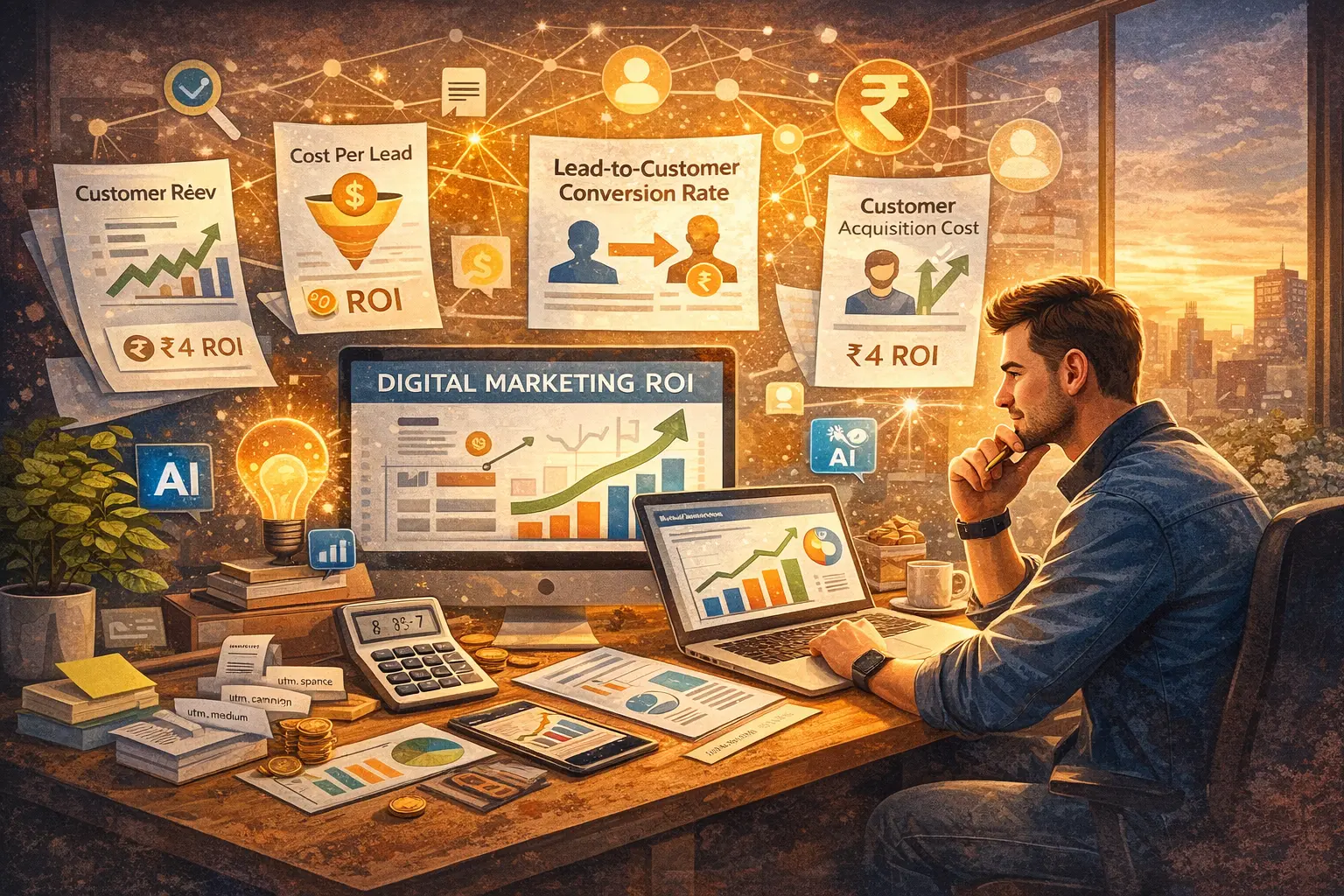
Cost Per Lead (CPL): How much does it cost you to generate one qualified enquiry? This is calculated by dividing your total marketing spend on a given channel by the number of leads generated from that channel.
Lead-to-Customer Conversion Rate: Of the leads you generate, what percentage become paying customers? This metric connects marketing activity directly to revenue.
Customer Acquisition Cost (CAC): What does it cost, in total marketing and sales effort, to acquire one new customer? Comparing this against your average customer value tells you whether your marketing is sustainable.
Customer Lifetime Value (CLV): A customer who buys once for ₹5,000 is less valuable than a customer who buys four times over two years for a total of ₹20,000. Understanding CLV helps you allocate marketing budget to the channels that attract the most valuable customers.
Return on Ad Spend (ROAS): For paid advertising specifically, ROAS measures revenue generated for every rupee spent. A ROAS of 4x means every ₹1,000 spent in ads generated ₹4,000 in revenue.
Building a Simple Reporting System
You do not need complex software to begin. A monthly spreadsheet that tracks leads by source, conversions by channel, and spend by campaign gives you more clarity than most businesses have. Connect Google Analytics to your website. Enable conversion tracking on your Google Ads. Set up UTM parameters on your email links so you can see which campaigns drive the most traffic and revenue.
Review this data monthly, not daily. Daily fluctuations create anxiety without insight. Monthly patterns reveal what is actually working.
Using AI for Faster Insights
In 2026, AI-enabled analytics tools within platforms like Google Analytics 4, Meta Ads Manager, and HubSpot can surface insights automatically — flagging underperforming campaigns, identifying your highest-value customer segments, and recommending budget reallocations. These tools reduce the time required for analysis significantly.
Conclusion
Marketing without measurement is speculation. In 2026, you have everything you need to run a results-accountable marketing operation — the tools are available, the frameworks are proven, and the cost is accessible for businesses of every size. Choose three metrics to track consistently for the next quarter. Build a simple dashboard. Review it monthly. The clarity you gain will not just improve your marketing — it will transform how you make every business decision.