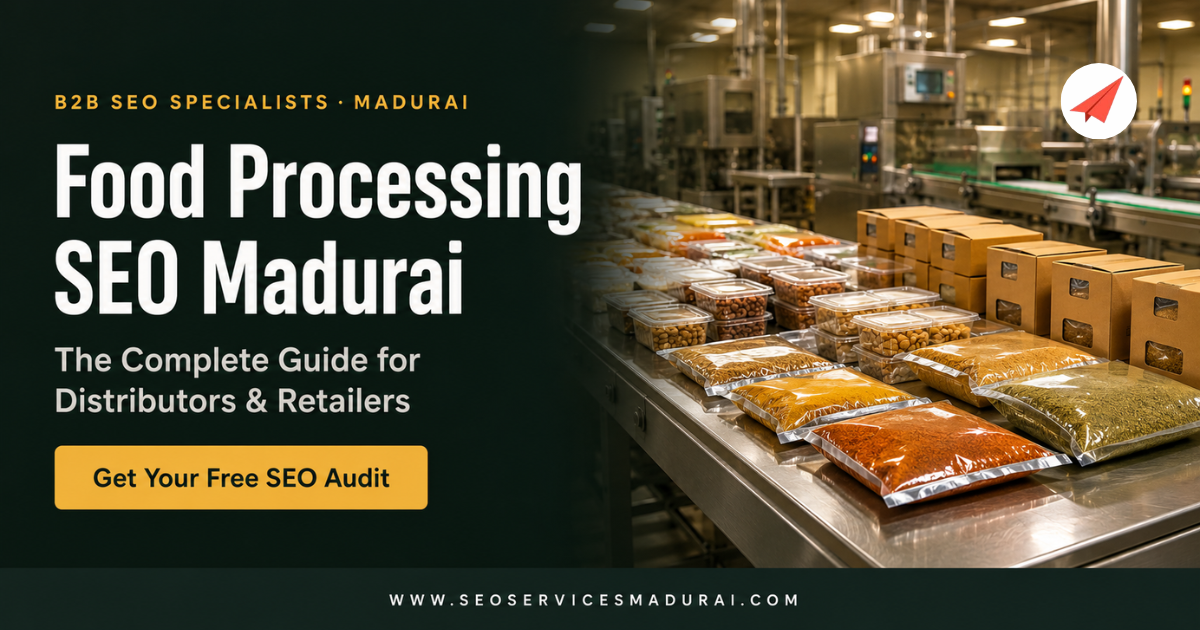
A retail chain’s procurement team doesn’t wander through an industrial estate looking for suppliers. They search online first, comparing food processing units on certifications, capacity, and product range before a single phone call happens. A clear food processing SEO Madurai strategy is what puts your unit in that comparison at all.
Food processing businesses across Tamil Nadu have historically grown through relationships — a distributor who’s worked with the family for years, a retailer who trusts your quality because someone vouched for you personally. That network still matters, but it has a ceiling. The distributors and retail chains you’ve never met, the ones actively searching for new suppliers right now, will never find you through word of mouth alone.
Why Food Processing SEO Differs From Consumer Food Marketing
It’s easy to confuse food processing marketing with restaurant or food-brand marketing, but the buyer is completely different. A restaurant markets to hungry diners. A food processing unit markets to procurement managers, distributors, and retail buyers evaluating you as a reliable, compliant, scalable supplier — not as a brand they personally want to eat from tonight.
This means the content that actually converts looks nothing like consumer food marketing. Appetizing photography matters less than clear information about certifications, production capacity, packaging options, and minimum order quantities. A buyer evaluating ten potential suppliers wants to quickly rule out the ones who can’t meet their volume or compliance requirements, and rule in the ones who clearly can.
Where Distributors and Retail Buyers Actually Search
Understanding the buyer’s research process shapes the entire strategy.
Google Search for Supplier Discovery
Buyers search using specific, functional terms: “spice processing unit Tamil Nadu bulk supply,” “FSSAI certified food manufacturer Madurai,” “private label snack manufacturer South India.” Generic terms like “food processing company” carry too much competition and too little buyer intent to be worth chasing directly.
Government and Export Portals for Credibility Checks
For buyers considering exports or larger institutional supply, resources like APEDA often factor into how they evaluate potential Indian suppliers, particularly around certification standards and export readiness. Being able to reference recognized standards and registrations on your own website mirrors the credibility signals buyers already look for through these channels.
Building a Food Processing SEO Strategy for Madurai Units
A working food processing SEO Madurai approach rests on three pillars: certification transparency, capacity clarity, and searchable product-specific content.
Certification and Compliance as Core Content, Not a Footnote
FSSAI licensing, ISO certifications, and any export registrations should have dedicated, detailed space on your website, not a single logo buried in the footer. Buyers evaluating unfamiliar suppliers look for this information early, and a business that makes it easy to find and verify signals far more reliability than one that treats it as an afterthought.
Capacity and Product Pages Built for Comparison
Distributors and retail buyers think in volumes, packaging formats, and shelf-life specifics. Dedicated pages for each product category — spices, snacks, dairy products, ready-to-eat items, whatever your unit produces — should include production capacity, available packaging sizes, shelf life, and private-label or co-packing options if you offer them. This level of detail lets a buyer self-qualify quickly, which speeds up genuine enquiries and filters out mismatched ones.
Location and Regional Content for Sourcing Buyers
Retail chains and distributors often specifically want suppliers from a particular region, either for freight cost reasons or to support regional sourcing initiatives. Content that clearly establishes your location, sourcing radius for raw materials, and delivery reach across Tamil Nadu and neighboring states helps match you to buyers who are specifically searching with those constraints in mind.
Content That Builds Long-Term Search Visibility
A blog or resources section covering topics like “how to choose a spice processing partner” or “understanding FSSAI food safety grades” does double duty. It captures long-tail searches from buyers still in the research phase, and it positions your unit as a knowledgeable, established player rather than an unknown name competing purely on price.
Seasonal and Festival-Driven Demand Planning
Certain categories within food processing see predictable demand spikes tied to festival seasons, and a strong food processing SEO Madurai strategy plans content around these windows rather than treating demand as flat year-round. Sweet and snack manufacturers see sharp search increases ahead of Diwali and Pongal, spice processors see steady interest tied to wedding season bulk orders, and packaged food suppliers often see retail chain enquiries rise ahead of festival stocking cycles.
Publishing capacity and lead-time information well ahead of these windows — a page confirming bulk order timelines for the Diwali season, for instance, published months in advance — helps you appear in front of retail buyers and distributors who are planning their stocking well before the rush actually hits. Waiting until the season is already underway to publish this information means competing for attention exactly when buyers have already shortlisted their suppliers.
Common Mistakes Food Processing Units Make Online
Certain gaps repeat consistently across food processing websites in this sector.
Many units have a basic website listing product categories with no detail on capacity, packaging, or certifications, forcing every serious buyer to email and wait for information they could have self-served. Others let their Google Business Profile sit outdated, with old photos and no mention of current certifications, weakening the exact trust signal that matters most in food supply relationships. And a large number of units have no content addressing export readiness at all, even when they’re well positioned to supply beyond Tamil Nadu or even internationally.
A more subtle issue shows up in how units describe themselves. Vague phrases like “quality food products” tell a buyer nothing useful, while specific claims — batch testing procedures, cold chain handling, shelf-life guarantees — give buyers exactly the comparison points they’re searching for.
One further gap worth flagging on its own: many food processing websites treat their “About Us” page as the only place certifications and history are mentioned, then never link to it from product pages where a buyer is actually evaluating a purchase decision. Certification and credibility information needs to be visible at the point of decision, not buried one click removed from where the buyer is actually reading.
Frequently Asked Questions
Do I need separate content for domestic distributors versus export buyers?
Generally yes, at least at the page level. Domestic distributors care most about consistent supply, pricing, and regional delivery reach, while export-focused buyers weight certifications, international compliance standards, and documented quality processes more heavily. Serving both audiences from one generic page usually undersells both.
How important is a Google Business Profile for a food processing unit that mainly sells B2B?
Still quite important, particularly for regional credibility and for buyers who search by location when sourcing suppliers within a specific radius. It works alongside, not instead of, detailed product and certification content on your main website.
Should food processing units target export-related keywords even if they’re not currently exporting?
It depends on capacity and long-term goals. If export is a realistic future direction, building foundational content around certifications and standards now makes that transition easier later, since this content also strengthens domestic B2B credibility in the meantime.
How long does it typically take to see results from food processing SEO?
Because B2B sourcing decisions involve more verification steps than consumer purchases, most units see meaningful enquiry increases within three to five months of consistent, certification-forward content work.
How GegoSoft Supports Food Processing Units
GegoSoft works with food processing units across Madurai and Tamil Nadu on exactly this kind of certification-forward, B2B-focused SEO strategy. Full detail on our approach for this sector is on our food processing industry page, alongside the local SEO services that help regional buyers find and trust your business.
Units just building out their online presence typically start well with our Bronze or Silver packages, scaling up as product and certification pages expand. Full scope and pricing for each tier is on our SEO packages page.
Getting Started
Every distributor or retail buyer who can’t quickly verify your certifications and capacity online moves on to a competitor who makes that information easy to find. A structured audit shows exactly where your current site stands against what serious B2B food buyers actually look for.
If you’re ready to see where your business stands, get a free SEO audit for your business and we’ll map out a clear action plan. You can also reach out directly if you’d like to talk through your specific product lines and target buyers first.
The distributors and retailers you haven’t met yet are searching right now. Making sure they find you, with the right information to trust you immediately, is entirely within your control.